'/%3E%3Cpath%20fill='%23b2b2b2'%20d='M241%20382q0%2016%2017%2026%2017%2011%2042%2011t42-11q16-11%2017-26V269H241'/%3E%3Cpath%20fill='%239f7e00'%20d='M241%20379q0%2014%208%2023%209%209%2021%209%2014%200%2021-9%209-9%209-23V269h-59'/%3E%3Cpath%20d='M241%20339v-70h59v110q0%2014-9%2023l-6%205v-68h-15v72q-8%200-14-4v-68zm59%2040c0%2022%2015%2032%2029%2032%2021%200%2030-18%2030-32v-40h-59'/%3E%3Cpath%20fill='%239f7e00'%20d='M266%20277v5h2v12h-3v-5h2v-5h-9v5h2v5h-4v9h3v18h-5v10h34v-10h-5v-18h3v-9h-4v-5h2v-5h-9v5h2v5h-3v-12h2v-5zm42%20101q0%2010%206%2017%206%206%2015%207%2010-1%2016-7%206-7%206-17v-29h-43'/%3E%3Ccircle%20fill='%230044ad'%20cx='329.5'%20cy='372'%20r='6'/%3E%3Cellipse%20fill='%230044ad'%20cx='300'%20cy='340'%20rx='16'%20ry='21'/%3E%3C/svg%3E)
'/%3E%3C/svg%3E)

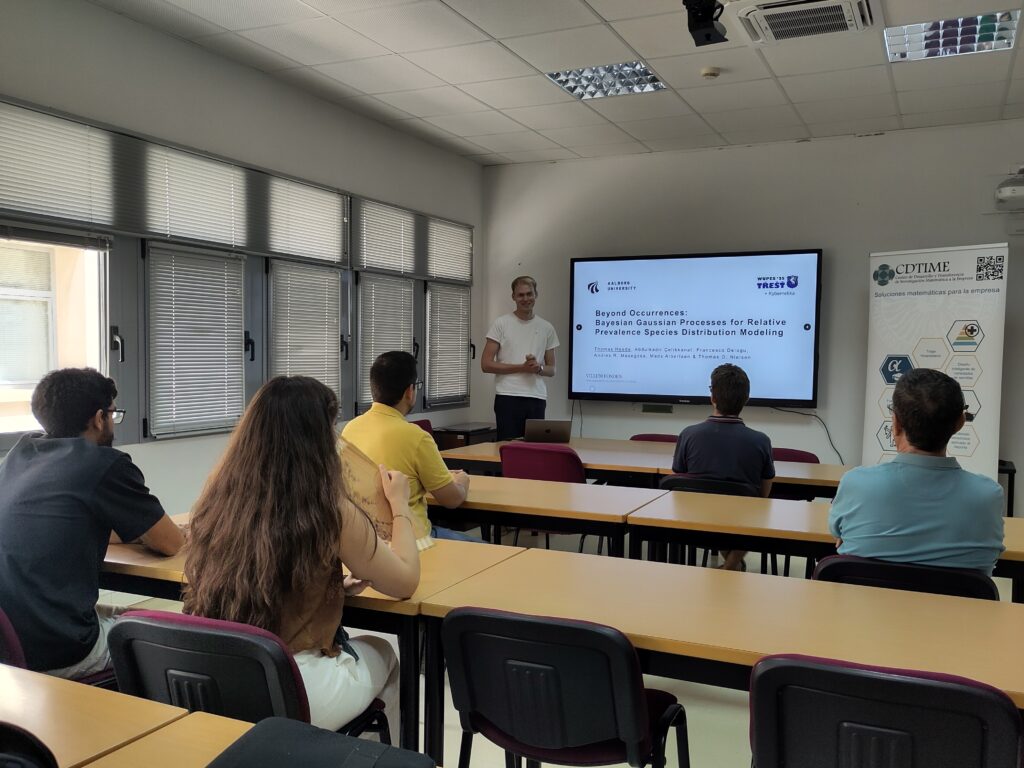
El próximo viernes, 19 de junio de 2026, a las 12:00 en el Seminario Paul Erdős (sala 2.42 del CITE III) tendrá lugar una charla titulada «Beyond Occurrences: Bayesian Gaussian Processes for Relative Prevalence Species Distribution Modeling».
Será impartida por Thomas Heede, estudiante de doctorado de la Universidad de Aalborg (Dinamarca).
Abstract:
Microorganisms are fundamental to the functioning of every ecosystem on Earth, yet their spatial distributions and environmental drivers remain poorly understood due to sparse observations, complex biotic dependencies, and intricate ecological processes. Species Distribution Modeling (SDM) provides a principled framework for addressing these challenges, but existing approaches often focus on single species, rely primarily on environmental features, focus on occurrence modeling, or provide limited uncertainty quantification.
We propose EcoGP, a Bayesian SDM framework based on additive Gaussian processes for jointly modeling microbial species distributions. The model represents species’ responses as the sum of environmental and spatial components, shared across species through latent processes, enabling joint analysis of entire communities while maintaining interpretability. EcoGP supports both presence/absence data and relative prevalence data through Bernoulli and Dirichlet-Multinomial likelihoods, respectively, allowing the framework to leverage richer ecological information when available. The proposed model is positioned within a Bayesian context to facilitate uncertainty-aware ecological analyses, including species-specific responses to environmental change and spatial location. To ensure scalability to large datasets, we derive a sparse variational inference and learning scheme tailored to the proposed model.
Empirical evaluations on synthetic data and several real-world datasets show that EcoGP achieves strong predictive performance compared to established SDM baselines on most datasets. Additionally, the interpretability of EcoGP is demonstrated, highlighting how the framework and the learned models can be used for gaining insight into the underlying biological processes.